From 1955 to present day what countries do most immigrants come from
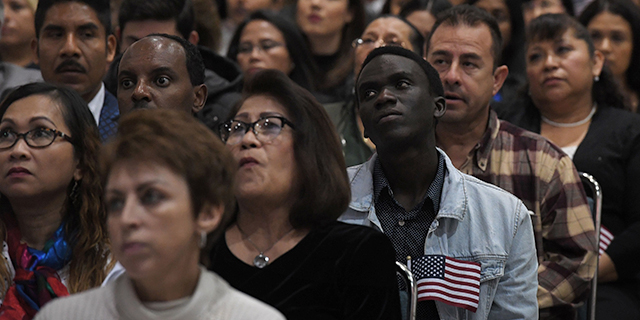
The United States has more immigrants than any other country in the world. Today, more forty one thousand thousand people living in the U.S. were born in another country, accounting for about one-5th of the world's migrants. The population of immigrants is likewise very diverse, with only most every land in the globe represented amongst U.S. immigrants.
Pew Research Center regularly publishes statistical portraits of the nation'due south strange-born population, which include historical trends since 1960. Based on these portraits, hither are answers to some key questions well-nigh the U.S. immigrant population.
How many people in the U.S. are immigrants?
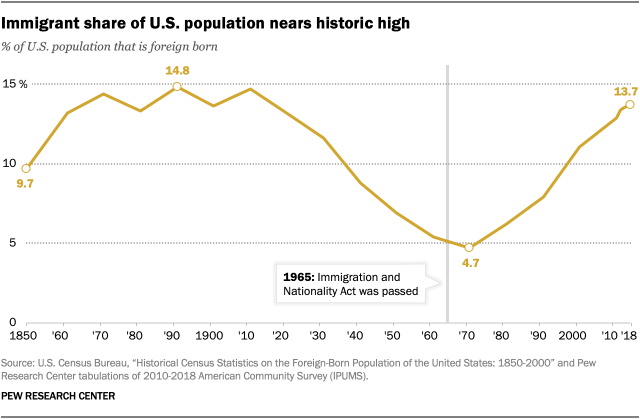
The U.S. foreign-born population reached a tape 44.viii 1000000 in 2018. Since 1965, when U.Due south. immigration laws replaced a national quota system, the number of immigrants living in the U.S. has more than quadrupled. Immigrants today account for xiii.vii% of the U.S. population, nearly triple the share (4.8%) in 1970. However, today's immigrant share remains below the record 14.8% share in 1890, when nine.2 million immigrants lived in the U.South.
What is the legal status of immigrants in the U.S.?
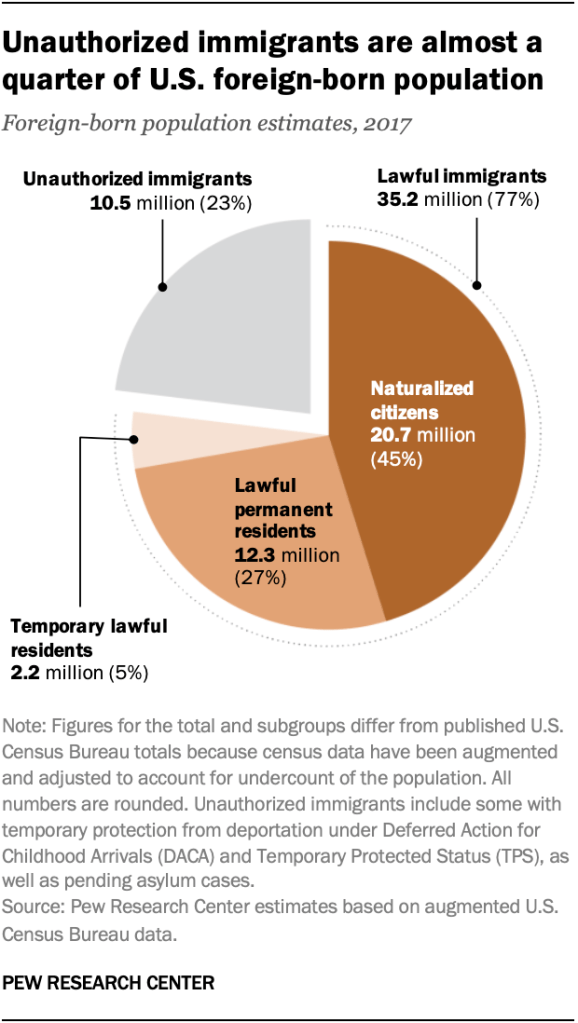
Virtually immigrants (77%) are in the country legally, while almost a quarter are unauthorized, according to new Pew Research Centre estimates based on census data adjusted for undercount. In 2017, 45% were naturalized U.S. citizens.
Some 27% of immigrants were permanent residents and v% were temporary residents in 2017. Another 23% of all immigrants were unauthorized immigrants. From 1990 to 2007, the unauthorized immigrant population more than tripled in size – from 3.5 million to a record high of 12.2 million in 2007. By 2017, that number had declined by i.7 million, or 14%. At that place were ten.5 million unauthorized immigrants in the U.S. in 2017, accounting for 3.2% of the nation's population.
The decline in the unauthorized immigrant population is due largely to a autumn in the number from Mexico – the single largest group of unauthorized immigrants in the U.S. Between 2007 and 2017, this grouping decreased past 2 meg. Meanwhile, at that place was a rise in the number from Central America and Asia.
Do all lawful immigrants choose to become U.S. citizens?
Not all lawful permanent residents choose to pursue U.Southward. citizenship. Those who wish to do then may utilise subsequently meeting sure requirements, including having lived in the U.S. for 5 years. In financial year 2019, nigh 800,000 immigrants practical for naturalization. The number of naturalization applications has climbed in contempo years, though the almanac totals remain beneath the 1.4 million applications filed in 2007.
Generally, virtually immigrants eligible for naturalization use to become citizens. However, Mexican lawful immigrants have the everyman naturalization rate overall. Language and personal barriers, lack of involvement and financial barriers are among the top reasons for choosing non to naturalize cited by Mexican-born greenish carte holders, according to a 2015 Pew Research Center survey.
Where practice immigrants come from?

Mexico is the pinnacle origin country of the U.Southward. immigrant population. In 2018, roughly xi.2 meg immigrants living in the U.S. were from there, accounting for 25% of all U.S. immigrants. The next largest origin groups were those from Cathay (6%), India (6%), the Philippines (4%) and El Salvador (3%).
Past region of birth, immigrants from Asia combined accounted for 28% of all immigrants, shut to the share of immigrants from Mexico (25%). Other regions make upwardly smaller shares: Europe, Canada and other N America (13%), the Caribbean (10%), Central America (viii%), Due south America (seven%), the Middle Eastward and North Africa (4%) and sub-Saharan Africa (five%).
Who is arriving today?
More than 1 1000000 immigrants make it in the U.S. each twelvemonth. In 2018, the acme country of origin for new immigrants coming into the U.S. was China, with 149,000 people, followed by India (129,000), Mexico (120,000) and the Philippines (46,000).
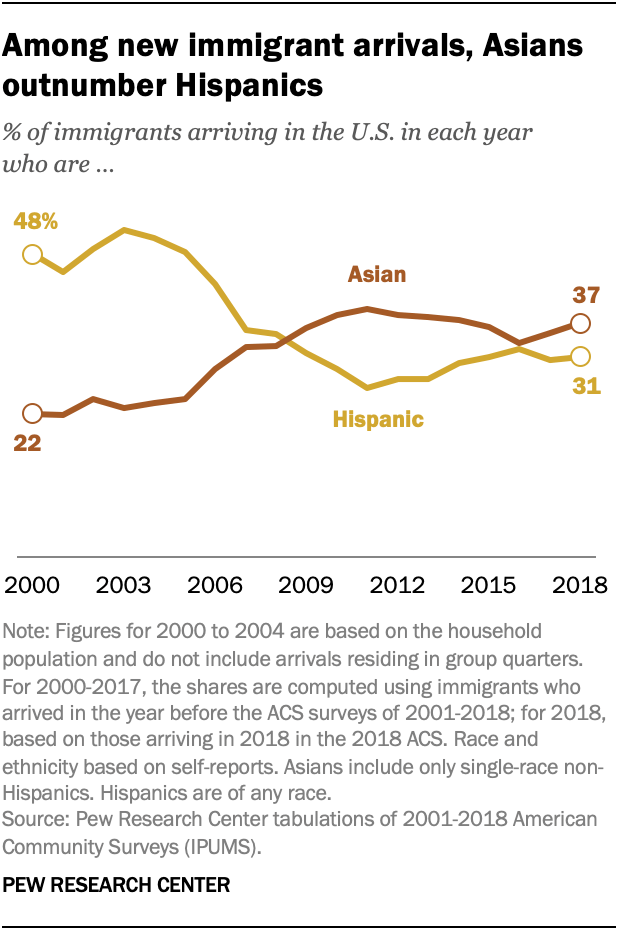
Past race and ethnicity, more Asian immigrants than Hispanic immigrants have arrived in the U.Due south. in virtually years since 2009. Immigration from Latin America slowed following the Dandy Recession, particularly for Mexico, which has seen both decreasing flows into the The states and big flows back to United mexican states in recent years.
Asians are projected to become the largest immigrant grouping in the U.S. past 2055, surpassing Hispanics. Pew Inquiry Middle estimates indicate that in 2065, those who identify as Asian will make up some 38% of all immigrants; as Hispanic, 31%; White, 20%; and Black, nine%.
Is the immigrant population growing?
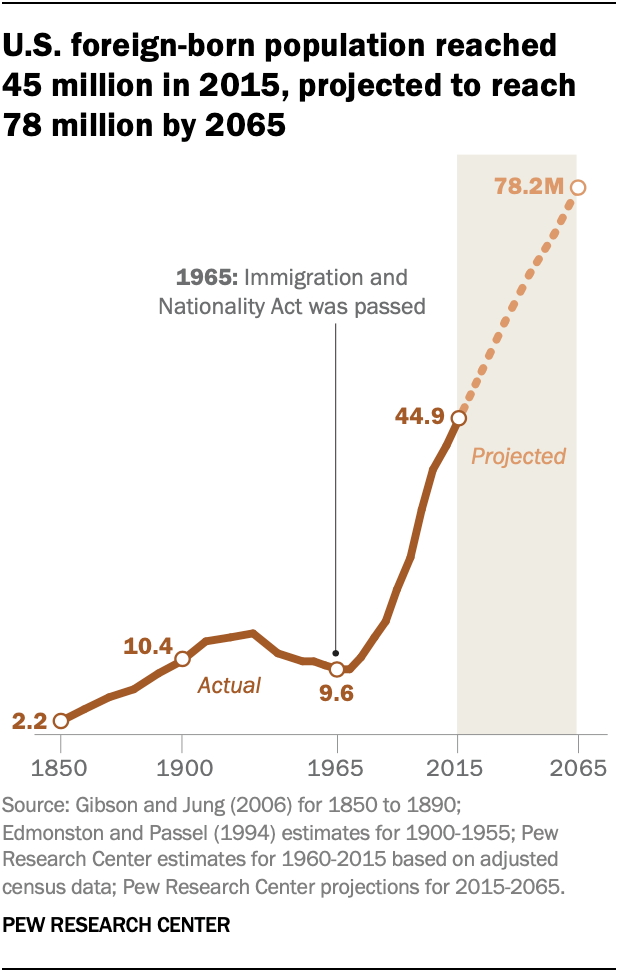
New immigrant arrivals have fallen, mainly due to a decrease in the number of unauthorized immigrants coming to the U.S. The drop in the unauthorized immigrant population can primarily be attributed to more than Mexican immigrants leaving the U.S. than coming in.
Looking forrad, immigrants and their descendants are projected to account for 88% of U.S. population growth through 2065, assuming current immigration trends continue. In addition to new arrivals, U.Southward. births to immigrant parents will be important to futurity growth in the land'southward population. In 2018, the percentage of women giving nascency in the by year was higher amidst immigrants (vii.v%) than among the U.South. born (5.vii%). While U.S.-built-in women gave birth to more than 3 million children that year, immigrant women gave birth to about 760,000.
How many immigrants have come to the U.Due south. as refugees?
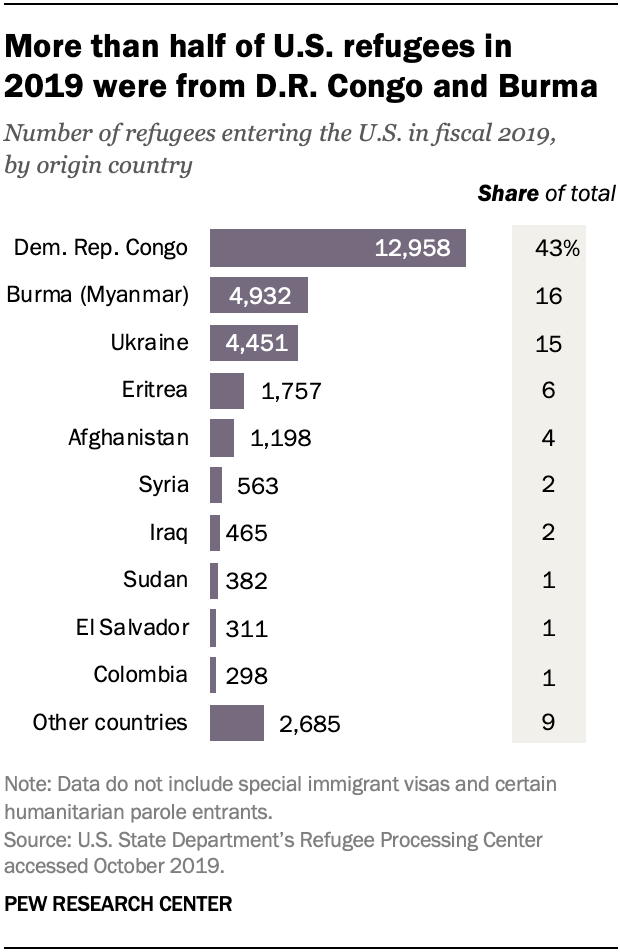
Since the cosmos of the federal Refugee Resettlement Programme in 1980, about 3 million refugees have been resettled in the U.Due south. – more than any other land.
In fiscal 2019, a total of 30,000 refugees were resettled in the U.S. The largest origin group of refugees was the Democratic republic of the congo, followed by Burma (Myanmar), Ukraine, Eritrea and Afghanistan. Among all refugees admitted in fiscal year 2019, 4,900 are Muslims (xvi%) and 23,800 are Christians (79%). Texas, Washington, New York and California resettled more than than a quarter of all refugees admitted in fiscal 2018.
Where do most U.South. immigrants live?
Nearly half (45%) of the nation's immigrants alive in just three states: California (24%), Texas (11%) and Florida (ten%). California had the largest immigrant population of whatsoever land in 2018, at x.6 million. Texas, Florida and New York had more than 4 meg immigrants each.
In terms of regions, nigh two-thirds of immigrants lived in the W (34%) and South (34%). Roughly one-fifth lived in the Northeast (21%) and 11% were in the Midwest.
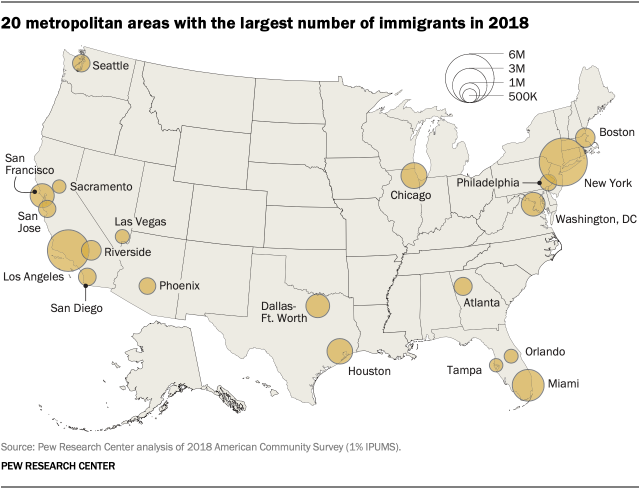
In 2018, most immigrants lived in simply 20 major metropolitan areas, with the largest populations in the New York, Los Angeles and Miami metro areas. These top 20 metro areas were home to 28.seven one thousand thousand immigrants, or 64% of the nation's total strange-born population. Nigh of the nation's unauthorized immigrant population lived in these top metro areas also.
How do immigrants compare with the U.Southward. population overall in didactics?
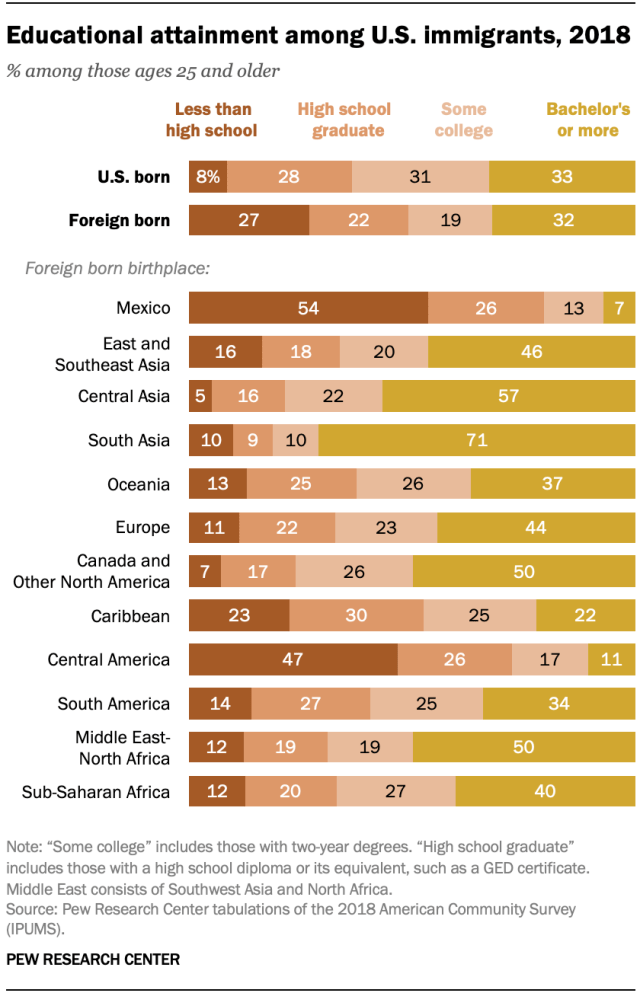
Immigrants in the U.Southward. equally a whole take lower levels of education than the U.S.-born population. In 2018, immigrants were over three times equally likely equally the U.S. born to accept non completed high school (27% vs. 8%). All the same, immigrants were just as likely as the U.S. born to have a available's degree or more than (32% and 33%, respectively).
Educational attainment varies amongst the nation'south immigrant groups, particularly across immigrants from dissimilar regions of the world. Immigrants from Mexico and Central America are less likely to be high school graduates than the U.Due south. born (54% and 47%, respectively, do not have a high schoolhouse diploma, vs. 8% of U.S. born). On the other mitt, immigrants from every region except Mexico, the Caribbean and Central America were every bit likely as or more likely than U.Due south.-built-in residents to have a bachelor's or advanced degree.
Among all immigrants, those from Southern asia (71%) were the most likely to have a bachelor's degree or more. Immigrants from United mexican states (7%) and Cardinal America (11%) were the least likely to have a bachelor's or higher.
How many immigrants are working in the U.S.?
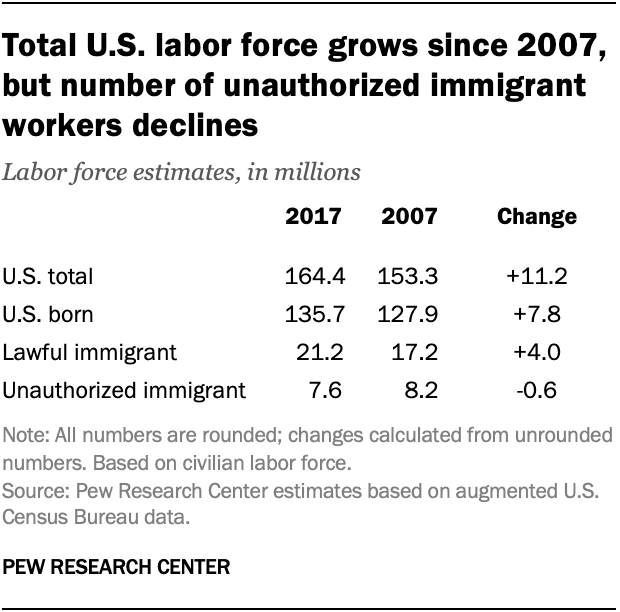
In 2017, about 29 million immigrants were working or looking for work in the U.Due south., making up some 17% of the total civilian labor forcefulness. Lawful immigrants fabricated up the majority of the immigrant workforce, at 21.two million. An boosted seven.half dozen million immigrant workers are unauthorized immigrants, less than the total of the previous year and notably less than in 2007, when they were eight.two million. They alone business relationship for four.half-dozen% of the civilian labor force, a dip from their peak of 5.iv% in 2007. During the same menstruum, the overall U.South. workforce grew, as did the number of U.S.-built-in workers and lawful immigrant workers.
Immigrants are projected to drive time to come growth in the U.Due south. working-age population through at least 2035. Equally the Baby Boom generation heads into retirement, immigrants and their children are expected to showtime a reject in the working-historic period population by adding about 18 1000000 people of working age between 2015 and 2035.
How well do immigrants speak English?
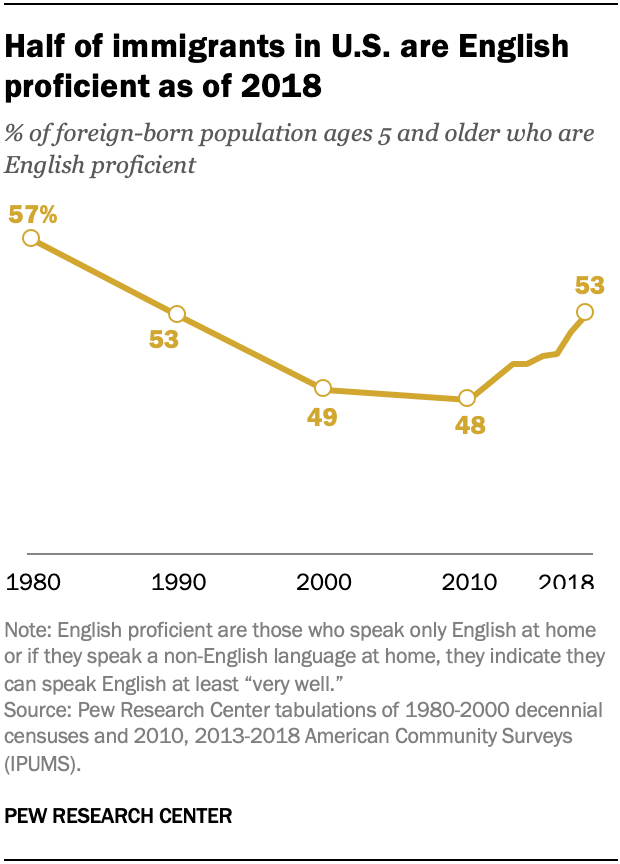
Among immigrants ages 5 and older in 2018, half (53%) are adept English speakers – either speaking English very well (37%) or only speaking English at dwelling house (17%).
Immigrants from Mexico have the everyman rates of English proficiency (34%), followed by those from Cardinal America (35%), East and Southeast Asia (50%) and South America (56%). Immigrants from Canada (96%), Oceania (82%), Europe (75%) and sub-Saharan Africa (74%) have the highest rates of English proficiency.
The longer immigrants take lived in the U.Due south., the greater the likelihood they are English adept. Some 47% of immigrants living in the U.S. five years or less are practiced. By dissimilarity, more than half (57%) of immigrants who have lived in the U.S. for 20 years or more are proficient English speakers.
Among immigrants ages 5 and older, Castilian is the most commonly oral communication. Some 42% of immigrants in the U.S. speak Castilian at dwelling. The acme five languages spoken at abode among immigrants exterior of Spanish are English language just (17%), followed by Chinese (six%), Hindi (5%), Filipino/Tagalog (four%) and French (iii%).
How many immigrants have been deported recently?
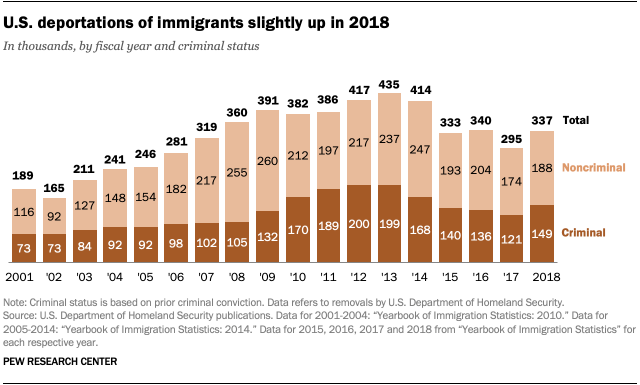
Around 337,000 immigrants were deported from the U.S. in financial 2018, up since 2017. Overall, the Obama assistants deported virtually three one thousand thousand immigrants between 2009 and 2016, a significantly higher number than the 2 million immigrants deported by the Bush administration between 2001 and 2008. In 2017, the Trump administration deported 295,000 immigrants, the lowest full since 2006.
Immigrants convicted of a crime fabricated up the less than half of deportations in 2018, the about recent year for which statistics past criminal status are available. Of the 337,000 immigrants deported in 2018, some 44% had criminal convictions and 56% were not convicted of a law-breaking. From 2001 to 2018, a majority (60%) of immigrants deported have not been convicted of a criminal offence.
How many immigrant apprehensions have place at the U.S.-Mexico border?
The number of apprehensions at the U.S.-United mexican states border has doubled from financial 2018 to fiscal 2019, from 396,579 in fiscal 2018 to 851,508 in fiscal 2019. Today, there are more than apprehensions of non-Mexicans than Mexicans at the border. In financial 2019, apprehensions of Central Americans at the border exceeded those of Mexicans for the quaternary consecutive yr. The first time Mexicans did not brand up the majority of Border Patrol apprehensions was in 2014.
How do Americans view immigrants and immigration?
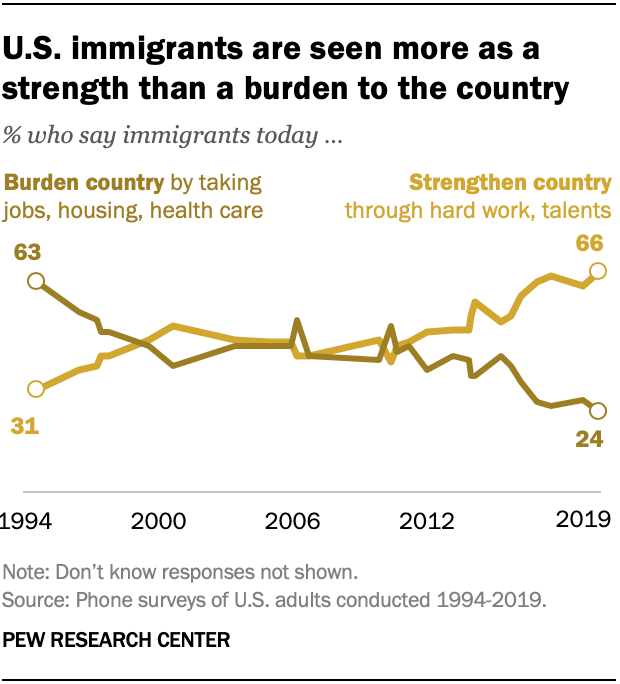
While immigration has been at the forefront of a national political debate, the U.S. public holds a range of views about immigrants living in the country. Overall, a majority of Americans accept positive views almost immigrants. About ii-thirds of Americans (66%) say immigrants strengthen the country "because of their difficult piece of work and talents," while about a quarter (24%) say immigrants burden the land by taking jobs, housing and health intendance.
Yet these views vary starkly by political affiliation. Among Democrats and Democratic-leaning independents, 88% think immigrants strengthen the country with their difficult work and talents, and just 8% say they are a burden. Amidst Republicans and Republican-leaning independents, 41% say immigrants strengthen the country, while 44% say they burden it.
Americans were divided on future levels of immigration. A quarter said legal immigration to the U.S. should be decreased (24%), while 1-third (38%) said immigration should be kept at its present level and almost another third (32%) said immigration should be increased.
Note: This is an update of a postal service originally published May 3, 2017, and written by Gustavo López, a former research analyst focusing on Hispanics, immigration and demographics; and Kristen Bialik, a former research assistant.
CORRECTION (Sept. 21, 2020): An update to the methodology used to tabulate figures in the chart "Among new immigrant arrivals, Asians outnumber Hispanics" has changed all figures from 2001 and 2012. This new methodology has besides allowed the inclusion of the figure from 2000. Furthermore, the earlier version of the chart incorrectly showed thepartial year shares of Hispanic and Asian recent arrivals in 2015; the correctedcomplete year shares are 31% and 36%, respectively.
Abby Budiman is a former inquiry analyst focusing on race and ethnicity research at Pew Research Eye.
Source: https://www.pewresearch.org/fact-tank/2020/08/20/key-findings-about-u-s-immigrants/
0 Response to "From 1955 to present day what countries do most immigrants come from"
Enregistrer un commentaire